“You pronounce it like you’re saying ‘chicken pizza’.” That’s how our tour guide explained how to pronounce #4 on the list of the New Wonders of the World.
The famous Mayan ruins are located on the Yucatan Peninsula of Mexico. It was summer 2009, one of our first trips together. We opted for a full-day tour that included the ruins, lunch, and a stop by Ik Kil Cenote (we had no idea what that was, but everyone said we needed to do it.) Our tour group picked us up first thing in the morning, and drove us through a quaint town or two, past agave plantations, and then down what felt like a never-ending road to the ruins.
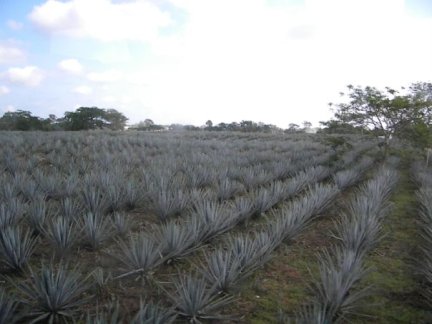
An agave plantation on the Yucatan peninsula. Agave is used to make tequila, among other things.
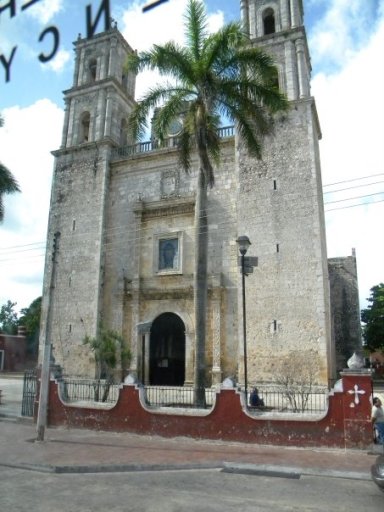
Each town in Mexico only has one church. According to our guide, you can tell the size of a town by the size of its church.
“Now, friends,” (this is how our tour guide spoke to us) “It is hot. You are not used to our Mexican sun. It is blistering, horribly hot. So once we get to the ruins, we will tour some of the highlights first thing before the sun gets too high in the sky. And then, you need to get in the shade. Do not be out in the sun during mid-day. When the sun gets high over the trees, you need to get under the trees. Trust me.” Right.
We listened, silently rolling our eyes. It might be hot to other people, but we were from eastern North Carolina. You cannot scare us with words like “heat”, “blistering”, and “sun”. Because we’d witnessed much worse: heat plus humidity. Yes, today would be a breeze compared to a summer’s day in NC. We’d also spent the last few days already in the Mexico, lounging at our all-inclusive ocean-side resort, Azul Sensatori Riviera Maya, and it didn’t seem so bad there. We would be fine.
Holy blistering heat, Batman. We were not prepared for the furnace that is the inner Yucatan peninsula. Even with a reasonable amount of cloud cover, it was as if the sun had commuted several light years towards the earth, and was now sitting just above our shoulder, intentionally broiling us, everywhere we went. If the sun had breath, I could have smelled what it had for breakfast. It was that hot. I remember standing in the shadow of taller people just to get some relief. And of course, against Chris’ advice, I did not wear a hat. I’m not even sure I owned a good hat at that point in my life. But if there were a sombrero market near-by, I would have happily handed over my money.

At the Mayan ruins of Chichen Itza, Mexico. At the moment, I’m grateful to be under the protection of my husband’s wide-brimmed hat.
Now there are a lot of theories about the Mayan people and civilization. But their understanding of mathematics, astronomy, architecture, and art are undeniable. In fact, the recent fear of the world ending on December 12, 2012 was based on a misinterpretation of the Mayan calendar. Actually, December 12 represented the end of 394 solar years, also called a b’ak’tun, as the Mayans measured time in lengths up to 63 million years. See below for other examples of Mayan ingenuity.
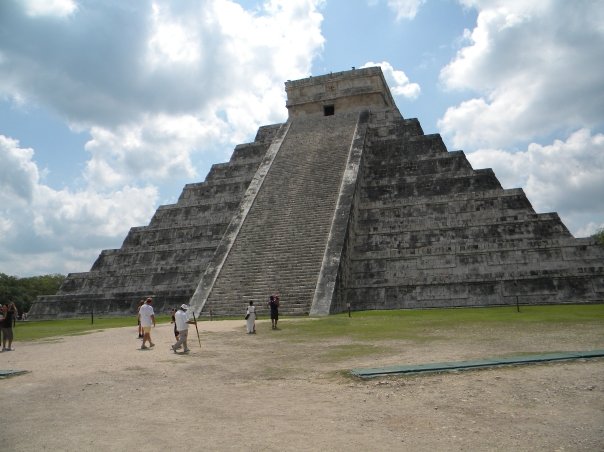
Above sits the iconic main building of the Mayan ruins of Chichen Itza. Thanks to tourist-induced vandalism, visitors are no longer allowed to climb the 91 steps to the top.
In the time the Mayan civilization was built, the modern-day calendar was not yet officially created. The Mayans were actually one of the first civilizations to believe that it took the Earth 364 1/4 to rotate around the sun, making one “solar” year. The above Mayan structure (the main building), has 91 steps on each of its 4 sides (4 x 91 = 364 days), plus one additional step at the very top (364 + 1 = 365 days in a leap year, every 4 years). That’s pretty close for a civilization that could only measure time by the alignment of the stars.


The above building on the left has a face directly in the center of the front facade (look about 10 feet above the doorway). Mayan architects were able to build the same face on each of the four corners (see images above and right for a corner and close-up view).
The Mayans were also no strangers to fierce competitive sports. Unfortunately, their versions of sports normally ended in a death, rather than participation ribbons. Below is the “field” for the Mayan game of pitz. The object was to get a 4 -9 lb ball through the hoop on either side of the court. The catch: players could not directly use their hands. Instead, they used their hips, forearms, bats, rackets, etc. As you can see from the pictures, the height of the hoops made this additionally challenging, with the hoops sitting over 20 feet from the ground. The winner of the game had the honor of beheading the captain of the opposing team. “Friendly” might not be the best description.


These inexplicable steps reminded me of the Labyrinth, as they were both upside down and lead to nowhere. Cue David Bowie.


We sought relief from the heat by visiting some local craftsmen stationed around the ruins. After bartering for some souvenirs, we found some book-ends and a miniature Mayan mask (these have since broken, by the way, thanks to some less-than-thoughtful moves with my Swiffer).
After we were thoroughly drained, we headed to our tour’s next stop: lunch. We were much relieved when they led us to the beautiful Hacienda Chichen, a breath-taking resort that could have easily inspired a Latin love story or two.


The resort was strategically placed so that most sitting areas and walkways were under breezy palms and huge canopy-like foliage. Peacocks and iguanas roamed freely around the grounds. And somehow, there was a constant breeze within the resort. A true oasis. Unbelievable that we were just a few hundred feet from the human baking sheet of the Mayan ruins.
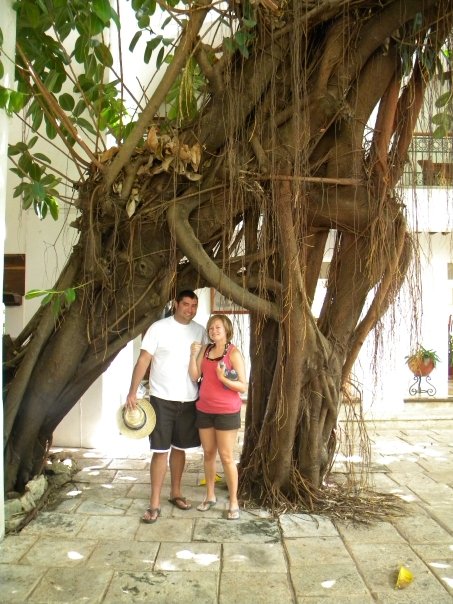
We felt compelled to get a shot with one of the gargantuan rainforest trees, for comparison purposes. Notice we are also measurably happier.
The last and most exciting stop of our tour was Ik Kil Cenote: an adventure worthy of its own blog post. But for now, I will say this: I appreciate we were able to visit the Mayan ruins of Chichen Itza. It was awe-inspiring to experience what a 750 BC civilization could accomplish. However, one visit was probably enough Mayan sun exposure for us.
 A Belle Abroad
Very good Katie! Send more!
LikeLiked by 1 person
Pingback: One Bad Jump at Ik Kil Cenote | A Belle Abroad