This is a two-part post. Part 1 was written before the incident at the US Capitol. Part 2 was written after and will include current travel warnings from the US Department of State, as well as those of other countries.
It’s not even really a question of why anyone would want to travel. To me at least, there are more reasons to want to travel than to not want to. But I may be limited in my views.
There are the obvious reasons: experience other cultures, see the wonders of the world, find reasons to use all Instagram filters, etc. But I recently came across a Netflix series that reminded me why seeing the world really invigorates my soul.
By chance, I was scrolling through Netflix, looking for a new binge, when I came across Cooked. Based on the book by Michael Pollan, the series documents the origins of modern cooking and how it has shaped the world we know. I’m not particularly interested in cooking – more eating, really. But I figured with a 5-star rating it was worth the hour.
Within the opening sequence, I was mesmerized. Not by food, mind you (they were preparing to cook iguana), but by the story-telling and perspective from other cultures. If you have not seen the show, 1.) you should start watching, and 2.) there are spoilers ahead.
In the next hour, I watched Michael Pollan discuss fire and its crucial presence in the role of cooking, particularly when it comes to meat. He began by highlighting an Aboriginal tribe in Australia, the Martu, native to the Australian bush. For tens of thousands of years, they lived completely off the land, using fire as a means to both hunt for and cook their meat-based meals. It was incredibly interesting to watch as they described their perspective of fire, what it means to their people, and how ultimately it brings them closer to the land.
We were then brought back to the modern-day United States, where Michael prepared to cook freshly killed meat over his own home-made oven, over a roaring fire. As he built an oven out of aluminum foil and a grill basin, he discussed his opinion that as a culture, we have lost touch with cooking meat over a fire in such an exposed way. Ovens, microwaves, and toasters all have a hidden fire element. But he revealed there was one tradition in the States that had not meandered from this way of cooking: barbecuing. And the one place that continues this in the most traditional way is…wait for it…Eastern North Carolina. That’s right. Good ole, vinegar-based, day-long, pig-cooking. We weren’t even halfway through the show and he had connected an Aboriginal tribal tradition on the other side of the globe with the most loved meal in my little corner of the world. Sidenote: by the end of the show, Michael Pollan had cooked his own pig in his little homemade “fire-oven-pit”, and had converted a vegetarian to a meat-eater. To quote everyone who has ever had eastern NC-style barbecue, “That’s some goooooooood eatin’.”
And this is why I love to travel. Because it brings together the familiar with the unfamiliar in a way that never would have happened otherwise. It gives me an opportunity to connect things across the world to the things close to me. It gives me a different perspective. It provides insight into origins, and a window into what could be to come.
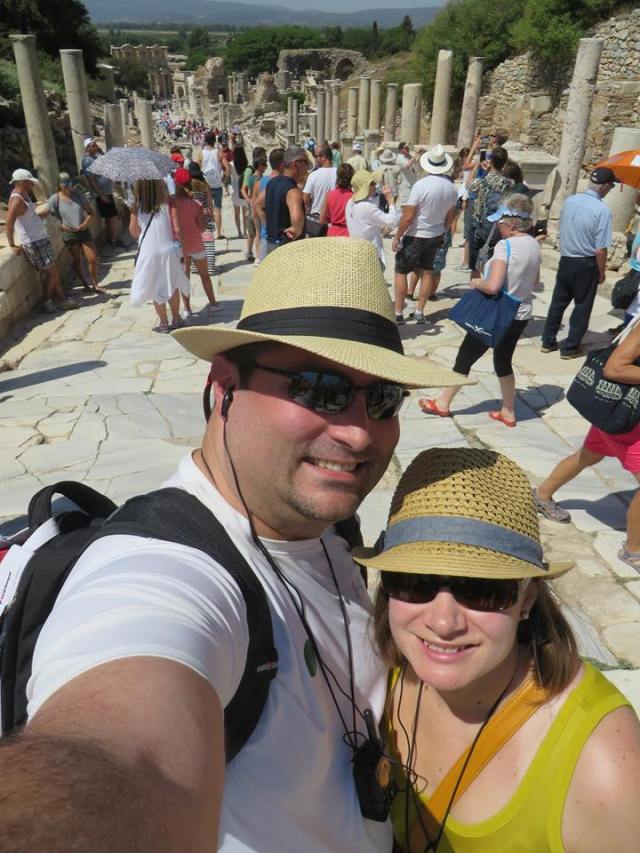
Because I’ve been amongst an Aboriginal tribe, and was taught how to throw a boomerang by an Aboriginal tribesman. Sure, I can watch a video on YouTube, and read an article on Wikipedia to learn. But reading and watching is not an experience. Reading and watching would not have led to my connection that throwing a boomerang is not at all like throwing a frisbee. And how different fountain water tastes in Venice versus that of Croatia. And how much easier it is to walk along the streets of Ephesus if you follow the footstep imprints. And how to politely shove your way onto the Paris metro. And the difference between the sound of waves crashing at Topsail Beach, NC, versus at Four-Mile Beach, Australia. And that a small town in Mexico isn’t that different from a small town in the South.

This is why I’m willing to leave the comfort and familiarity of my home to see and face the new and unfamiliar of another country. So I can experience. So I can hear, smell, feel, taste, and see for myself, with my own senses. So I can make my own connections, and draw my own conclusions. It’s not just about knowing there’s something different out there than what I’ve always known; it’s about being there myself. I can let someone else make connections for me. I can let someone else describe it to me. I can let someone else take pictures for me. But that means I’ll only see it through their eyes– an experience shaded by someone else’s perspective. That’s not good enough for me. While I’m healthy and able, I need to see things for myself. Like the simplicity of a bike-sharing system in big cities like Berlin as a clean transportation option. Like the normalcy of a glass of wine at a business lunch in Paris. Like the undeniable logic in a 10:00am – 4:00pm workday in Ireland, or 2-hour lunch break in Italy. Like how friendly the Turkish people are in-person.
Yes, I could certainly accept and succumb to the portrayal of other countries through media outlets. But I’m also capable of forming my own opinions and making my own connections. So why not do that. Just take out the middle man, and see the world for myself. Break the limits of my views. And have some fun in my adventures while I’m at it. Because the fear should not be in the unknown. The fear should be in never learning more than we know right now.
 A Belle Abroad